
The Realistic SA-10 Stereo Amplifier
This page focuses on the Realistic SA-10 amplifier. The SA-10 is a small audio amplifier intended for use in entry level low power stereo systems (those that might be used in a den, office, etc). It is by no means a powerhouse amp, however it is a very good little amp for many situations where a low power system is adequate. I use one in my basement laboratory (it is connected to a pair of 10" 2 way speaker systems) and it provides more than adequate sound for what I want in that environment. This amp is no longer offered by Radio Shack (I bought mine around 1979 for $29.95, however it was dropped from their line a number of years ago). The SA-10 is widely available on Ebay for around $10 - $25 (sometimes people want like $50 for this amp, too high in my opinion unless you want one for nostalgia reasons). I sometimes see outlandish specs posted on line for this amp, this page will provide the true facts about this amplifier (see my resume for credentials).
Radio Shack actually published specs for this small amp (they are listed in the owner's manual). Here are the published specs:
A few words on the above specs. First, any audiophile knows that 10% distortion is a very high amount. I measured the power output of this amp and it can put out about 0.75 watt per channel with very low distortion (I did not measure the THD but the sine wave output at this level was very clean). The Phono input on this amp does NOT have a preamp, it is basically a high level line input (no different than a CD input for example). If you want to use this amp with a turntable that has a magnetic cartridge (in other words about 95% of all turntables in use today) a phono preamp will be required. If you wanted to connect a microphone to this amp a mic preamp will be required. The Tape/Tuner input means tape or tuner (one or the other, not both). The bottom line is that this amp has two line level inputs. Like most entry level Radio Shack amps, the SA-10 has a built in loudness curve (meaning that the frequency response of the amp favors the low end when the volume controls are at the lower end of the scale).
1.2 Watts per channel? Who would want
that measly power? Well, the fact is most people don't realize how loud a 1 watt
per channel amp can sound, and they are similarly surprised at how "quiet" a 100
watt per channel amp is (compared to a 1 watt per channel amp)! The human ear
"hears" things logarithmically, which basically means it takes a LOT of power to
make something sound a lot louder. Twice the power only makes the sound slightly
louder. For most people, to make something sound significantly louder requires
about 10 times the power to the speakers. The bottom line is that 1 watt
per channel is more than adequate for a den system, a small bedroom system
,etc. Again, don't plan on shaking walls down with this unit, but do
expect a very nice sound for a basic entry level system.
What speakers can be used
with the SA-10? In truth, most any speaker will work (8 ohm speakers would
be preferable). Although you can use large high power speakers with this
amp, this amp is really intended to be used with smaller bookshelf
speakers. Speaker connections on the back of the amp are via RCA
connectors.
WARNING:
DO NOT ATTEMPT TO WORK ON ANY ELECTRONIC
EQUIPMENT UNLESS YOU ARE THOROUGHLY QUALIFIED TO DO SO. FAILURE TO ADHERE
TO THIS WARNING CAN RESULT IN RUINING THE EQUIPMENT, BURNING DOWN YOUR HOUSE OR
IN EXTREME CASES, DEATH.
Below is the schematic for the SA-10 (this is from the SA-10 owner's manual): Click on the image below and a large version will open up in a new window.
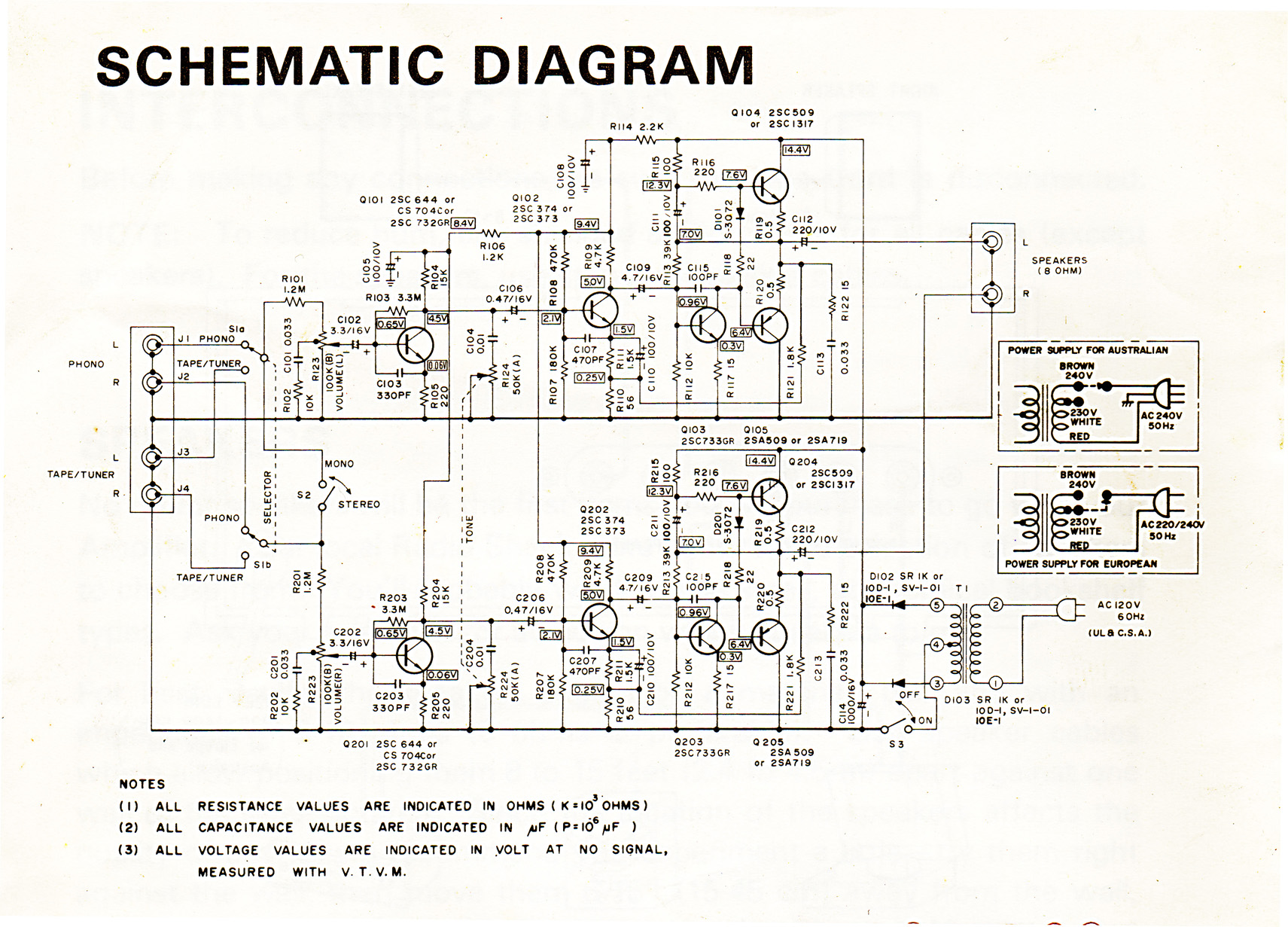
Discussion of the SA-10 electrical design: There are a few shortcomings with the design of
this amp. However, keep in mind that this (at the time) was the most entry level amp
in Radio Shack's line and it sold for $29.95, so one cannot expect a rock solid
world class quality design. Keeping that in mind, here are my comments (some of this will not
make sense if you do not have a background in electronics):
Bottom line: There are some things I would have done differently if I was the designer. Again, for the price class, a decent unit.