Updated 14 April 2013
Advice for First Time Telescope Buyers
If you are new to astronomy and contemplating the purchase of your first telescope, this page will help you to better understand
what to look for in a telescope and what to expect from it. There are many telescopes aimed at beginning astronomers, and first
time buyers are often overwhelmed by all the choices, brands, etc. This page will arm you with the basic information you will
need to get off to a good start in astronomy.
The contents of this page applies to small to medium sized, beginner (or "first")
telescopes. By small, I mean 2.4 inch (60mm) to roughly 3.5 inch (80 to 90mm) refractors, and 4.5 to 6 inch (100-150mm) reflectors .
Telescopes in this beginner class typically sell for around $150 to $600. Quality starter telescopes are available from
a number of manufacturers. The buyer should be aware that there are quite a few very poor quality telescopes in the marketplace; these
are most often found in "department stores". It is hoped that the information on this page will help out prospective new
astronomers and to advise them not to expect too much from a small telescope. If you have any questions, please send e-mail to Joe Roberts and I'll try to help! If you want to know more about me
and my background in astronomy, please visit here!
First...BEFORE you buy a telescope!
Many experienced amateur astronomers will tell you that the best way to get into astronomy is
to first learn some of the basic constellations, and then use a pair of binoculars to find your
first astronomical objects. It is important to learn the
basics of finding your way around the sky (you will need these
skills to find objects using a telescope). Binoculars really can
show quite a number of interesting sights in the night sky. A good pair of binoculars will often cost less than a
telescope; in fact, if your budget only allows spending about $100, you might be better off buying a decent pair of
binoculars and a good starter book rather than a telescope. Most experienced amateur astronomers agree that
"jumping in" with a fancy expensive telescope without first learning the basics is not the best way to get involved. Astronomy is a
fascinating hobby but it's not for everyone. If you spend $1000 on
a fancy telescope and then later find you're not really into it, you will have wasted a considerable amount of
money. Binoculars are a great way to get a taste of what backyard astronomy can offer. Another great way to start
in astronomy is to visit a local astronomy club (most larger cities have some kind of club). Clubs often have loaner scopes, or at
minimum, there will be members that will be happy to show you a number of telescopes. Binoculars can be a good first step,
but they won't show any detail on the planets (and limited detail on the Moon). If you have a pair now, do try them
out!
Ready for a telescope? Please read on!
Number One: Have Realistic Expectations!
DON'T EXPECT a small telescope to show images
like those you may have seen in magazines. Those pictures are
likely from the Hubble Space Telescope or some other large professional
telescope. If you are expecting "video game" or "Hollywood" type images with amazing detail and vivid color, you will be in for
a pretty big letdown.
What can you expect to see? Below we will describe what you might reasonably expect to see with small
telescope:
- The Moon: The Moon is a target that will show tremendous detail in virtually any telescope. Even a telescope as
small as 2.4 inches (60mm) will reveal a wealth of detail. You'll be able to see craters, mountains, "seas", and a number of
other fine details. The Moon rarely disappoints a first time viewer! Contrary to popular belief, Full Moon is not the ideal
time to look at the Moon with a telescope; first (and last) quarter is the best time. During this phase the Moon's details will
be lit from an angle and this allows much more detail to be seen!
- Mercury: Mercury is hard to see because it never gets far enough away from the Sun to be easily visible. If you do manage to locate it in a telescope, it will appear very small and at best you will only see the phase. Surface detail is only barely detectable by the most experienced astronomers using world class equipment under ideal conditions.
- Venus: Venus is also is also fairly close to the Sun and visible only during the evening or morning skies, however it is easy to spot as it is very bright. When you do see it expect only to see its phase in a telescope; no surface detail will be seen since the planet's surface is permanently hidden by a thick, white atmosphere.
- Mars: Mars is easily seen in a small telescope, but often a big disappointment to first time viewers. It only
reveals subtle detail when it is close to Earth (and this occurs for a period of about 2 months every few years). When Mars is
close to Earth, you might see a white polar cap, and perhaps some surface markings. The biggest problem with Mars is that it's a
small planet. Even at high powers in a large telescope Mars at best looks about the same size as a tennis ball viewed (with the
naked eye) from about ten feet!
- Jupiter: Jupiter is the planet that consistently shows the most detail in amateur telescopes. However, even at high
magnification Jupiter will only look about the size of some of the medium sized craters on the Moon. On any given night you'd be
able to see a few cloud bands, the 4 Galilean Moons, and maybe the Great Red Spot. Jupiter is easy to find (when visible) as it is
among the brightest objects in the night sky.
- Saturn: Saturn will show its glorious rings, but the planet will not look too large even at magnification of around
100 power. Keen eyed people (with good viewing conditions) might also spot some subtle cloud bands. Saturn's largest moon Titan will
also be visible nearby but only as a moderately bright dot.
- Uranus: You'll need to know exactly where to look to find Uranus (it is only barely visible to the naked eye under dark skies). At best it will look like a small green dot in the telescope. Even
in large telescopes Uranus shows only as a small, featureless disk!
- Neptune: Like Uranus, you'll need to know exactly where to look (it's too faint to see with the naked eye), and at best Neptune will look like a somewhat dim
small blue dot (it won't really look any different than a star). No amateur scope can see any detail on Neptune.
- Pluto: Pluto is out of the question for a small telescope; it generally requires an experienced observer using at
least an 8 inch telescope (in a dark sky with a highly detailed finder chart) just to see it as a very faint dot!
- The Sun: You can look at the Sun with a small telescope, however you MUST USE A SPECIAL FILTER FOR OBSERVING THE
SUN WITH ANY TELESCOPE. Failure to do so will result in permanent eye damage and possible blindness. DO NOT attempt
solar observation unless you are certain you have the correct special equipment
AND you know proper procedures. Solar observation is safe if you adhere to proper procedures! You can see sunspots and
solar "granulation". If in doubt about observing the Sun, have an experienced amateur astronomer with you prior to
solar observing... your eyesight is at stake!
- Stars: Stars stars will look brighter in a telescope but they will not look any larger. No amateur telescope has
anything close to the power required to make a star look larger! They are simply too far away... The color of stars will be more easily visible in the telescope however.
- Deep Sky Objects: In addition to planets and the Moon, there are a number of other
objects within the reach of a small telescope. These are the so called "deep sky" objects. These include galaxies,
star clusters, nebulae, and double stars. However, the quality of the view you will have on these kinds of objects
depends to a very large degree on how much light pollution you have in your area (more on light pollution below).
To locate most of these objects you'll have to use a star atlas (first you'll have to learn the basic constellations in order to
find your way around the sky). Again, don't expect to see galaxies and nebulae like they appear in most magazine photos. Most
galaxies and nebulae appear as "fuzzy patches of light" in small (and even large) telescopes. Star clusters and double
stars are often quite beautiful and are good targets for small telescopes.
NEW: To gain an idea of what Saturn might look like through a small telescope, check out this article: Simulated Telescope Images.
Number Two: Don't blame the telescope for things it can't control!
Many beginners don't realize that a telescope's performance is
often at the mercy of local ambient conditions.
Other than the obvious (clouds, fog, etc.), there are several
other major factors which limit how much can be seen.
Light pollution is by far the biggest problem facing today's astronomers. Light Pollution has (for all practical purposes) completely ruined the skies in and around of just about every moderate to large city (this means that unless you live out in the country the only things you'll probably be able to see well are the Moon and bright planets).
Light pollution is caused by excessive amounts of and/or poorly
designed outdoor lights. Light pollution will not degrade the viewing
of the Moon and planets, but it can seriously limit the
number of non-solar system objects you might otherwise see (objects
such as galaxies, star clusters and nebulae). Light pollution
has invaded almost all populated areas of the country. Often,
the only remedy is to drive to a dark location, generally 50 to 100 miles
or so from any major city (and even at this distance evidence
of light pollution may remain readily visible). For more information on light
pollution, see my article dedicated to this topic: Light Pollution.
For a very comprehensive treatment of light pollution, see the
International Dark Sky Organization's web site at www.darksky.org.
The next problem that impacts astronomy (but not nearly as much as light pollution) is known as seeing conditions. When you look at an astronomical target, you are seeing it through
the Earth's atmosphere, which essentially is an "ocean of
air". Very often the atmosphere is highly unsteady, due to
thermal variations in the upper atmosphere, air currents near the ground, etc. All of this means that
an image passing though it will be distorted to some degree. Have you ever
looked at something across a hot asphalt parking lot in the summer? The objects in the distance seem to shimmer. Now, imagine
looking through miles of turbulent air at high magnification! In short,
bad seeing conditions can severely limit the amount of fine detail
you can see on the Moon and planets (fortunately bad seeing has much less effect on galaxies,
star clusters and nebulae). Seeing conditions are often a function of where you live. Areas like Florida are known for good
seeing (New England seeing is often notoriously poor). Also, avoid setting up a telescope in a manner that requires you to look
at objects over a house, parking lot, etc. The heat that such items absorb during the day gets radiated at night and can fowl
the seeing conditions even more! To see what bad seeing looks like, take a look at this video clip of the Moon (taken through a telescope) during poor seeing conditions. See how it appears to shimmer...
Finally, it is important to give a telescope a chance
to cool down to the outside temperature (especially for Newtonian Reflectors and Schmidt Cassegrain type telescopes). Cooling down of
the scope is called thermal
stabilization. If a telescope is brought from a warm
house out to the cold night, the images seen through it
are likely to be very poor at first, perhaps to the point where
the telescope won't even seem to focus at all. This is because
the optics in the telescope are undergoing a change in size and shape due
to the temperature difference. The actual change in the
optics is extremely small in human terms; however, at
the wavelengths of light, it is very significant. Bottom line:
Make sure a telescope has time to cool down to the outside temperature
before expecting it to perform at its best. Acceptable performance
is usually reached with 15 to 20 minutes, but the very best performance
may take one hour or more (depending on the temperature differential and the type of telescope).
Storing a telescope in an unheated garage may help to shorten
the time it takes to cool; alternatively, set the telescope outside an hour or so before
you plan to use it. .
Number 3: Use LOW magnification, and make sure your scope
is properly adjusted!
If you take away only one thing from reading this page, let it be this : Magnification is NOT a measure of a
telescope's quality or capabilities! Many beginning astronomers think that high magnification is they
key to great viewing. This is a common misconception. A telescope's "power" is a function of the diameter of its mirror (or
lens). In general, bigger is better for telescopes!
Ask any experienced amateur astronomer and they will tell you that most observing is performed
using low magnification. For small telescopes,
low magnification (or "power") means anywhere from about
30x to about 50x. High power is useful (and often necessary)
for viewing the Moon, planets and double stars. However, initially finding
a planet (or any object) is much easier to do using low power.
Even users of large telescopes use lower magnification most of the time. The highest
magnification that is useful in a typical beginner telescope is in
the range of 100x to 200x . Small telescopes do not gather enough light for satisfactory high
power views of galaxies and nebulae. Although it may be technically possible to achieve, using a small telescope at a magnification around 500x will virtually guarantee that you will see nothing at all!
The image below shows the results of using appropriate magnification and excessive magnification. The leftmost two images of
Saturn are representative of what you might expect to see
at low and high power respectively (in a typical entry level scope). The image at right shows what happens when magnification is
pushed to excess. The image is bigger to be sure, however
the clarity is terrible, the image will be very shaky and much dimmer. No additional detail can be seen as a result of this
extreme (but useless) magnification! The image at right is typical of what you might see
in an entry level telescope that claims "675x magnification". The most magnification you will normally use is about 50x per inch
of lens (or mirror) diameter. For a 3" scope this would be about 150x. To emphasize one more time: most of
your observing will be done at LOW magnification!
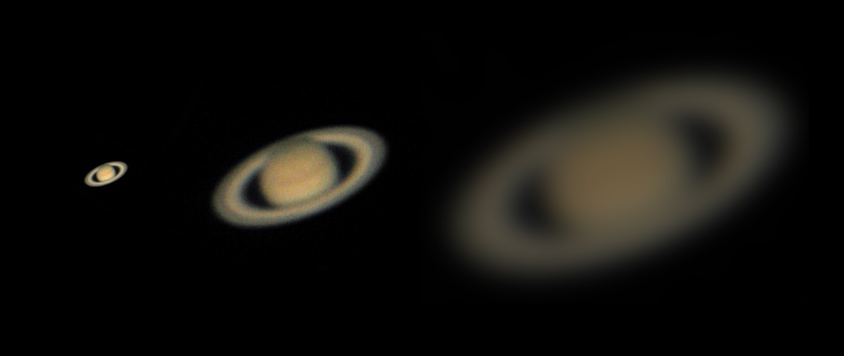
Representative views of Saturn at low, high and excessive magnification! (view this image from about 5 feet back from your
monitor to get a more realistic sense of what the real thing will look like). Note that things get dimmer and less clear as the magnification goes up!
Another factor that can impact the quality of what you see is alignment (or "collimation") of the optics. Newtonian reflector
telescopes require this from time to time (optics in refractor telescopes almost never require adjustments). If
the optics are out of alignment, you will still "see"
through the telescope, but very likely the images won't focus
properly, or the image will seem somewhat distorted. The manuals for telescopes from all quality vendors will include
instructions on how to collimate the optics. Once adjusted the alignment will hold unless the scope takes a good "bump" (or a
ride in the trunk of a car on a bumpy road). Collimation tools are also available for around $40 and are a great help
simplifying the aligning the
optics. If you want to eliminate the (occasional) task of aligning optics, a refractor telescope would be the way to go.
Number 4: Telescope Quality
As far as beginner telescopes are concerned, there are many telescopes on the market that are best avoided. Fortunately there
are more great choices today than ever before (and at very reasonable prices). Ideally you will spend $500 to get started with an excellent package, however I know that this is out of reach for many. Fortunately there are some nice choices in the $100 range (stick with the ones I recommend however, do not buy any old $100 scope you find)! Many beginner telescopes make performance claims that are
preposterous, and are of very poor mechanical and optical quality. You are better off buying a simple (but well made) telescope.
In other words, buy a telescope where the money has gone into basic functionality
(good optics and a good mount). Telescopes to be avoided are easily identified, since they come standard with numerous (but often
useless) accessories (more on this below)!
Of paramount importance in any telescope is optical quality.
While a beginner telescope cannot offer custom hand made
and certified state of the art optics, ones from reputable
manufacturers are generally very good. I strongly recommend avoiding so called "department
store" (Wal Mart, Toys R Us, etc) telescopes. Some scopes available from such vendors have a satisfactory main optic, but
most of the time the eyepieces (discussed below) are of marginal quality. The very worst telescopes have
plastic lenses... needless to say, these units will have extremely poor performance.
The second most important part of a telescope is its mount.
There are numerous types of mounts (beyond the scope of this article).
They key is to make sure the one that comes with the scope you're
considering is smooth, stable, and solid. Few things are more frustrating to the beginning astronomer than
fighting with a shaky telescope mount that won't stay put on an object! Poor mountings will make using high magnification
especially annoying and frustrating. Purchase a
telescope with a simple (but quality) mount.
Another of the important items that come with a telescope are the
eyepieces. The eyepiece is where you "look" through the telescope. Eyepieces come in a variety of types and sizes; using different ones allows you to change
the magnification of the telescope. Many low end telescopes
provide 2 or 3 poor quality eyepieces (many of which result
in a magnification well beyond the useful capability
of the scope). For small beginner telescopes, it is much better
to have one or two quality eyepieces (as opposed to a
battery of marginal eyepieces). What is best for a beginner? Look for one eyepiece that produces low magnification
(about 30x - 50x) and a second one for higher magnification (about 100x to 120x). Eyepieces are marked with letters and numbers; these
characters denote focal length (and often the optical design) of the eyepiece. Beware of telescopes that have eyepieces
with any or all of the following markings: H25, H20, H12.5, and SR4. If the scope has one or more of these eyepieces, it is
likely that the images will be marginal to poor. The "H" stands for "Huygens", one of the poorest performing optical designs
available (they are inexpensive to manufacture however). "SR" stands for Symmetric Ramsden. Trust me on this: no small
telescope will benefit from an SR4 eyepiece. The manufacturer simply includes this so that the high end magnification of the
telescope sounds very impressive (it is a marketing ploy). Most people will find using an SR4mm eyepiece extremely frustrating.
The SR4mm eyepiece has what is known as very poor eye relief. If you wear glasses, the SR4mm eyepiece will be
impossible to look through. Eyepieces with poor eye relief require that your eye be very close to them, often uncomfortably
close even for those who do not wear eyeglasses. The bottom line: Any telescope will have sharper and brighter images when LOW
magnification is used. And, finding objects will be MUCH easier! To read more about eyepieces please see my Eyepiece Fundamentals page.
Number 5: What Brand Telescope is Good?
In the beginner telescope market, this question has become clouded in the last 15 years or so (the good news is that there are more choices than ever before and plenty of great beginner scopes). Meade and Celestron are two major
telescope companies; in years gone by all the telescopes offered by these companies were good to excellent. That has
changed today, unfortunately the name Meade or Celestron on a telescope no longer guarantees that the scope is a good one.
Meade and Celestron have made a much bigger presence in the "consumer" telescope market in the last decade or twos. In the 1970's,
if you owned a Celestron telescope, you owned a good telescope (period). Back then, all of their telescopes (about 4 models)
were American made. Today, both Meade and Celestron market telescopes that are not ideal choices. Both Meade and Celestron still make some outstanding products; the problem is that people just starting out don't necessarily know which ones to avoid. Another vendor of a number of excellent starter scopes is Orion Telescopes and Binoculars .
.
"Made In China" For better or worse, this is a fact: nearly all entry level telescopes available today are made in
China. Here's the thing to be aware of: China does have the capability to manufacture some pretty decent optics. There are
two flavors of Chinese telescopes. The ones you want are ones that are designed and built to American specifications and quality
control standards. There are many Chinese telescopes available from many outlets that are manufactured under no particular
controls, and these are the ones that are probably best to avoid. Quality control can be an issue so there's some chance you'll get a "dud". Stick with the major brands and you are more likely to get a
good scope!
Number 6: Computerized Telescopes
Many telescopes available today employ electronics, the main purpose of which is to help you locate objects in the sky. So called "Go to" telescopes locate things for you (you dial them up on a hand held controller). A second type (less common) type of computerized teelescope is called "push to". These will also help you find
objects, but you physically move the scope while looking at a readout that guides you to your desired target.
All computerized telescopes require some kind of initial alignment (they have to be told "where they are" so they can subsequently locate things). After an initial alignment, you punch in the name of
an object or select it from a list (usually through a hand held control) and the scope will go and find it for you. Do they
work? Sometimes... but that statement comes with a number of qualifications. A number of the beginner go to telescopes in the
market have had problems quality control and precision (although this has improved in the last few years). Some other points concerning GOTO scopes: (1) it costs money to add this feature; on a beginner scope (in my opinion) the money available should go into the optics as compared to electronic gadgetry. (2) Many GOTO scopes have libraries containing "tens of thousands of objects". The problem is (especially in the light polluted environment that most users will be in) that the vast majority of these objects are far too faint to be seen in a
small telescope (even in very dark skies). In reality, the number of objects that will be visible (and interesting to a
beginner) is probably less than 100 (one hundred). On any given evening maybe only 10 or 15 of these will be visible!
Personally, I am not a fan of low priced GOTO telescopes and I do not recommend them at the entry level price range. From my
observations, the ones that are available in
the entry level class simply do not work very well. I recently tried to help a young person at a star party who had an entry
level go to scope (Meade). I was not terribly impressed with the scope's ability to locate objects. Despite a careful setup and
alignment, the scope could not reliably place objects into the low power field of view (it was not too far off but for each
object tried some manual button pushing was needed to get the object into the field of view). As an experienced observer I knew
what to do to get the desired object into the field of view (after the scope got me close), but someone starting out would not
have this knowledge. This would be frustrating to someone starting out as the scope might "just miss" showing one of the easily
visible targets (the first time viewer will say "I don't see anything!). There are GO TO scopes that DO work well, however these
are in a price class that (to me) is not in the entry level class (such scopes are typically over $500 and are often over
$1000).
I grew up in the "old school" of amateur astronomy, that is, I learned the sky and learned to "star hop" to objects
I wanted to observe. A higher end GOTO telescope does have some remarkable capabilities nonetheless. It can allow you to locate a
number of objects in a short time. However, there is a drawback. While a GOTO scope can locate objects for you, it
denies you the opportunity to learn your way around the sky. A GOTO scope is kind of like a car that takes you to
any address you specify, but with no knowledge (or view along the way) of how to get there. With the star hop
method, you learn to recognize star patterns and often you see interesting things along the way. While I am not a major
fan of entry level GOTO scopes, I do recognize that some people do like them a lot, and for some applications they can be quite
helpful. For example, if you have light polluted skies, it may be hard to use the "star hop" method of locating
objects because there are not many stars that can be seen (necessary for star hopping). A GOTO scope will find
things for you even if there are few stars visible to the naked eye. However, if your skies are particularly poor,
don't expect to see much through the main scope either. Another thing about GOTO scopes: there is more stuff to act
up and break down. A simple scope with a basic mounting is for all practical purposes a lifetime instrument, there
are few if any parts that will ever wear out or stop working. Sooner or later (due to the sophisticated electronics,
gears, motors, etc), most GOTO scopes will likely develop some kind of problem. So, I tend to not recommend entry level scopes
with GO TO features, however that is my personal opinion. (The high priced ones are fine, but again, much more money).
Number 7: Where to buy a Telescope
There are a number of places to buy a telescope... however I advise against purchasing a telescope at a department
store (Wal Mart, K-Mart, Toys R Us, etc)! Astronomy (today) is a fairly niche interest and as a result you will almost certainly have to buy your scope from an on-line vendor. There are a few towns that have superb telescope stores, but they are very rare and chances are you don't live anywhere near them.
The following is a list of on-line/mail order outfits I have personally
dealt with, and recommend without hesitation (please note that
there are many more I have not dealt with that are probably just
as good!):
- Orion Telescopes and Binoculars, (800) 447-1001
(Telescopes of all kinds, especially good "first" telescopes, excellent free catalog). I've purchased from them many times since 1984. Here is a listing of some Orion scopes that are excellent choices for a First Telescope.
- Astronomics (major distributor of numerous telescopes
and accessories). Visit them on the web at www.astronomics.com. Good honest people, a family owned business since 1979, I've dealt with them many times.
I recommend avoiding most Tasco telescopes (for reasons explained in my article Tasco Telescopes:
Why they are to be avoided (and how to fix them up)). If you buy from the so called "New York Camera Stores" be sure you know what you want. These outlets do carry good scopes, the problem tends to be that the people that work at these outfits generally do not really know what they are talking about when it comes to telescopes (and service is less likely to be personal). Be very wary of telescopes sold at "Brookstone",
"Radio Shack", and most "chain" type camera stores. Again, look for the classic sign of a low end telescope: eyepieces marked
H25, H20, H12.5, and/or SR4 along with a long list of accessories and a fancy box covered with pictures (which were probably
taken by a large professional telescope). If you see any of these, I recommend that you look elsewhere! The bottom line:
you want to buy your first telescope from a store or company that specializes in telescopes!
I've got $400 to spend... What's my best bet?
As mentioned at the beginning of this article, it's best to first learn the constellations and to have sampled
the skies using a pair of binoculars. If you've done this and you have a thirst for more, you are ready to move up
to a
telescope. In my opinion, $400 is probably the least you can spend to get a truly decent starter scope and
a few accessories you'll need to round out the package. Most astronomers will tell you to buy the biggest telescope you can
afford, and I generally agree with this statement. With a $400 budget, my personal recommendation for a starter package would
include a 6" Dobsonian reflector telescope. A 6" scope is big enough to show good detail on numerous objects, and yet is quite
portable. A 6" Dobsonian scope (like the ones Meade, Celestron and Orion sell) will eat up about $300 of your budget (including
shipping costs). The remaining $100 should be used to purchase another good quality eyepiece (about $40 - $60) , and also
a good book (I'd suggest NightWatch by Terrence
Dickinson, available at most decent bookstores).
by Terrence
Dickinson, available at most decent bookstores).
No scope is perfect for everyone, but if there is one I had to pick that best fits this requirement it is the
Orion SkyQuest XT6 Classic Dobsonian Telescope :
:
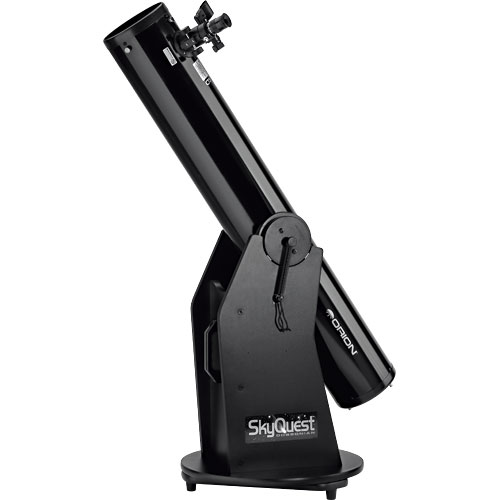
This scope is a great balance between capability and portability, plus it utilizes a classic 6" F8 design (meaning it is "good"
at viewing all kinds of astronomical targets). This scope got great reviews in the astronomy press. I have used them at star
parties, they are well made and great performers and hard to beat for the cost. A scope like this will far outperform most
anything you are likely to find at Wal Mart, Costco, etc. A scope like this can keep you busy for many years! I have several
other excellent starter scopes described in my article Excellent First Telescopes.

Other potential sources for telescopes include Ebay, however you are at some risk (you have no assurance that
the scope is not damaged, etc). Every once in a while you can find a nice scope at a tag sale, but you need to know enough
about the unit to decide whether it is worth the cost. People who have and are selling good scopes usually know what they have,
and they will not show up for $25 at a tag sale! As mentioned previously, local astronomy clubs might be your best option to get
introduced to a telescope. You may be able to get a loaner scope from a club, one that might cost a lot more than you might
want to spend. Also, should you find you are not into astronomy, you can always turn the scope back in and no money is lost.
Some other thoughts...
It is very important to keep in mind that small (and even large) amateur telescopes will not
provide visual images like those seen in astronomy books and magazines (the Moon is a possible exception). For many objects, you
must take satisfaction in just knowing that you have
barely detected a faint smudge of light! Only a few of the brightest
objects will be considered impressive by the average person.
If you go into astronomy expecting brilliant, color filled views
of objects in the sky, you will likely be disappointed. Amateur astronomy is not about dazzling "video game"
graphics and Hollywood special effects. Amateur astronomy is not unlike learning to appreciate fine art; you must learn to
appreciate what you see in your telescope, which in many cases will only be a very faint patch of light (and this may occur
while freezing your butt off or by being bit by a swarm of mosquitos). Even though you might be only able to just barely
glimpse a faint galaxy, know that you are seeing an incomprehensibly small portion of the light generated by a billion suns,
light which has traveled a journey of humanly unimaginable distance, a journey lasting many millions of years! When
you look at a distant planet in a telescope, you are seeing the real thing, live, and you can be sure that only an
extremely small fraction of people on Earth are looking at the same object at the same time! You will not be able to see
anything close to the American Flag on the Moon. However, you can look at these distant objects
like the Moon, the planets and galaxies, knowing that you (nor anyone else) will likely never visit them in person, and wonder
what it might be like if you could actually personally visit them. You also know that these objects are countless times older
than any person alive, and that they will still be there long, long after Mankind has ceased to exist on Earth.
"Back" links, e-mail and Copyright
Use your browser's "back" button, or use links below if you arrived here via some other path:
This page is part of the site Amateur Astronomer's Notebook.
The Joe Roberts Home Page: www.RocketRoberts.com/joe.htm.
E-mail to Joe
Roberts
Images and HTML text © Copyright 2003-2010 by Joe Roberts. Please request permission to use
photos for purposes other than "personal use". Telescope image copyright Orion.